 Jaipur, Rajasthan
Three Forts of Jaipur in One Day
By Bharat Trails Editors··5 min read·
Amber, Jaigarh and Nahargarh sit on one ridge and share one ticket. Here is the order to do them in, the timings that matter, and where lunch fits.
Jaipur's three forts are usually sold as three separate half-day trips, which is how a lot of visitors end up doing one of them and skipping the other two. They do not need to be. Amber, Jaigarh and Nahargarh sit on the same Aravalli ridge within a few kilometres of each other, they were built by the same dynasty as a single defensive system, and the composite ticket covers all three. One long day, run in the right order, gets you all of it.
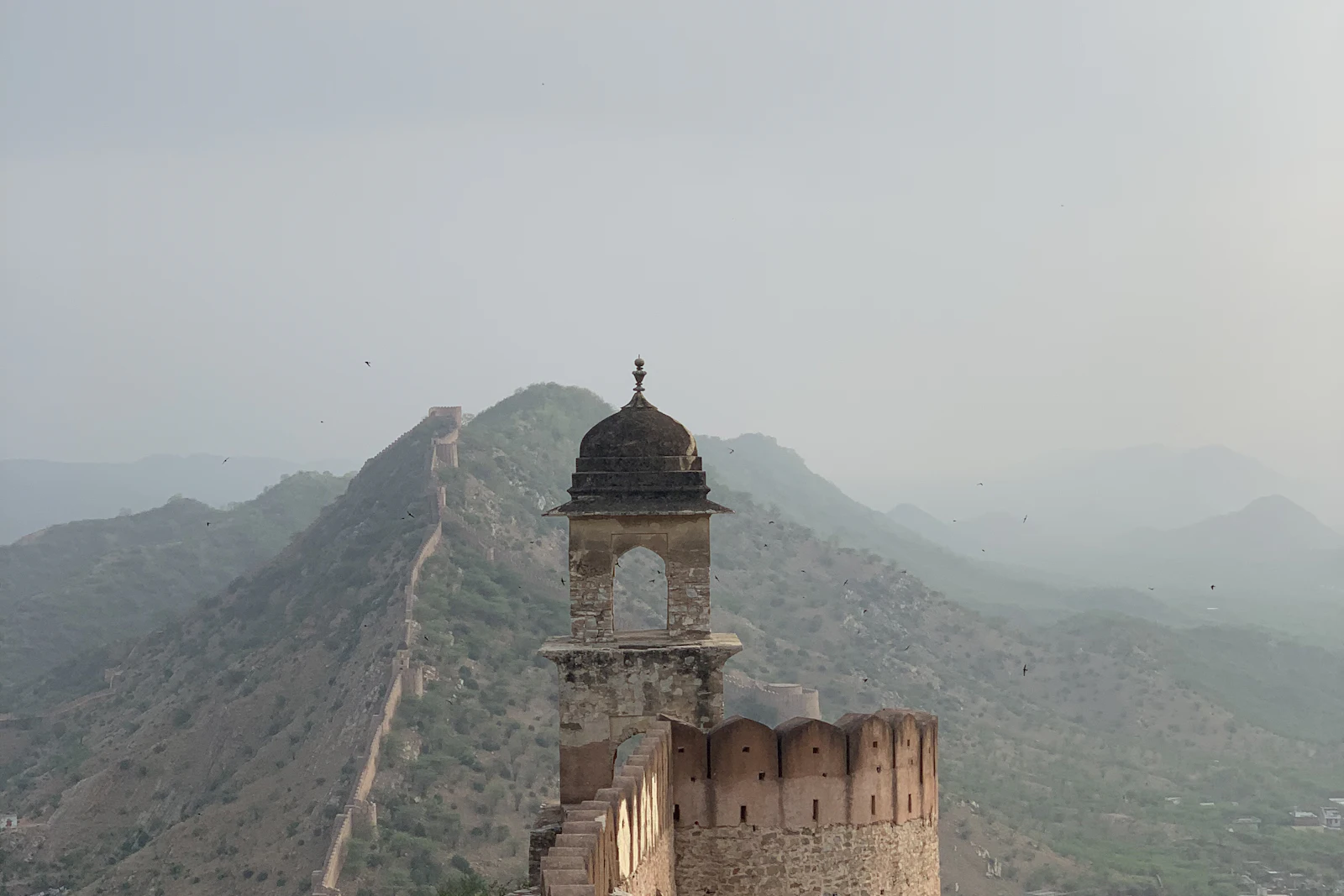
The right order is dictated by the sun. Amber faces its lake and takes the morning light; Nahargarh looks down over the whole city and takes the sunset. Jaigarh, which has neither view nor shade to speak of, goes in the middle where the heat does the least damage.
08:00 — Amber, before the coaches
Amber Fort opens at eight and this is not a soft recommendation. By half past ten the Sheesh Mahal has a queue, and by noon the courtyards are radiating stone heat for eight months of the year. Raja Man Singh I began the palace in 1592 and four generations kept building, which is why the styles inside argue with each other so pleasantly. It joined the UNESCO Hill Forts of Rajasthan listing in 2013.
Go in through Suraj Pol into the Jaleb Chowk, the parade court, then up to the Ganesh Pol, a gate painted in mineral colours that is the best single piece of surface decoration in the fort. Behind it the Sheesh Mahal gets the attention — a hall inlaid with convex mirrors so that a few candles read as a night sky — but the cleverer room is the Sukh Niwas opposite, where a marble channel carried water through the chamber and the breeze off it did the work of air conditioning three hundred years before there was any.
Skip the elephant rides. The animals climb a stone ramp in heat all day, welfare investigations have been repeatedly unkind, and the same climb is fifteen minutes on foot or a few hundred rupees in a shared jeep. Leaving by the Chand Pol gate rather than back the way you came puts you in Amber town, which almost nobody sees.
10:30 — Jaigarh, and the cannon that was fired once
Jaigarh stands on the hill directly above Amber and the two are connected by a fortified passage, built so the royal household could be moved up to the stronger fort under attack without ever stepping outside a wall. Sawai Jai Singh II completed the present fort in 1726. It is a working military installation rather than a palace: water reservoirs, a foundry, a granary, an armoury, and thick walls with very little decoration.
What everyone comes for is Jaivana, cast at the fort's own foundry in 1720 and for a long stretch the largest wheeled cannon in the world. The barrel is over six metres long and weighs around fifty tonnes. It was test-fired exactly once and never used in a battle, which is either an indictment of Jaipur's military planning or proof that it worked perfectly as a deterrent.
Two things within a few minutes of Amber's base that take twenty minutes each, if you have the appetite:
- Panna Meena ka Kund — an eighth-century-style stepwell with criss-crossing symmetrical staircases, free to enter, and almost empty before ten.
- Anokhi Museum of Hand Printing — a restored haveli in Amber town explaining block printing properly, after which the textiles in the bazaars stop looking interchangeable.
- Jal Mahal — the water palace on Man Sagar, which you cannot enter. Stop on the causeway for five minutes, photograph it, move on. It is a viewpoint, not a visit.
13:00 — lunch, and the part of the day you spend indoors
Come back into the city, eat properly, and then do nothing for two hours. This is not laziness; it is the only way the plan works from March to October. Dal baati churma is the local lunch and it is heavy enough to enforce the rest all by itself. If you want to be usefully indoors instead, Albert Hall Museum and the City Palace both have air conditioning and will take an hour each.
16:30 — Nahargarh, for sunset
Nahargarh was built in 1734 as the third point of the ridge defence and never saw an attack either. Its best feature is a later addition: Madhavendra Bhawan, built in the 1880s as nine identical apartments for nine queens, connected by corridors arranged so the maharaja could visit any one of them without the others knowing which. The rooms are small, faded and genuinely strange to walk through.
The reason to be here at this hour is the view. The whole of Jaipur lies below, and the grid Jai Singh laid out in 1727 to the principles of the Shilpa Shastra is legible from up here in a way it never is from inside it — nine rectangular blocks, straight streets meeting at right angles, the city wall drawn around them. The light goes pink over it and then the streetlights come on. Stay for both.
A last note on season. From November to February this whole day is a pleasure and you may want a jacket at Nahargarh after dark. From April to June it runs past 40°C and the honest version of this plan is Amber at eight, nothing at all until five, and Nahargarh for sunset — drop Jaigarh rather than pretend.