 Jaipur, Rajasthan
Three Days in Jaipur
By Bharat Trails Editors··5 min read·
A first-timer's three-day plan for the Pink City — the walled town on foot, the forts before the heat, and where to sit down when it wins anyway.
Jaipur rewards a plan more than most Indian cities do. Everything worth seeing is either inside one square kilometre of walled old town or eleven kilometres north of it, the good light lasts until about ten in the morning, and the afternoon is hot enough for eight months of the year that fighting it is a waste of a holiday. Three days is enough to see the city properly if you spend your mornings outside and your afternoons indoors.
The pink, incidentally, is not ancient. The old city was painted terracotta in 1876 to welcome the Prince of Wales, the colour stuck, and a municipal bylaw has kept it that way ever since. What you are looking at is a very old grid wearing a very persistent coat of paint.
Day one: the walled city, on foot
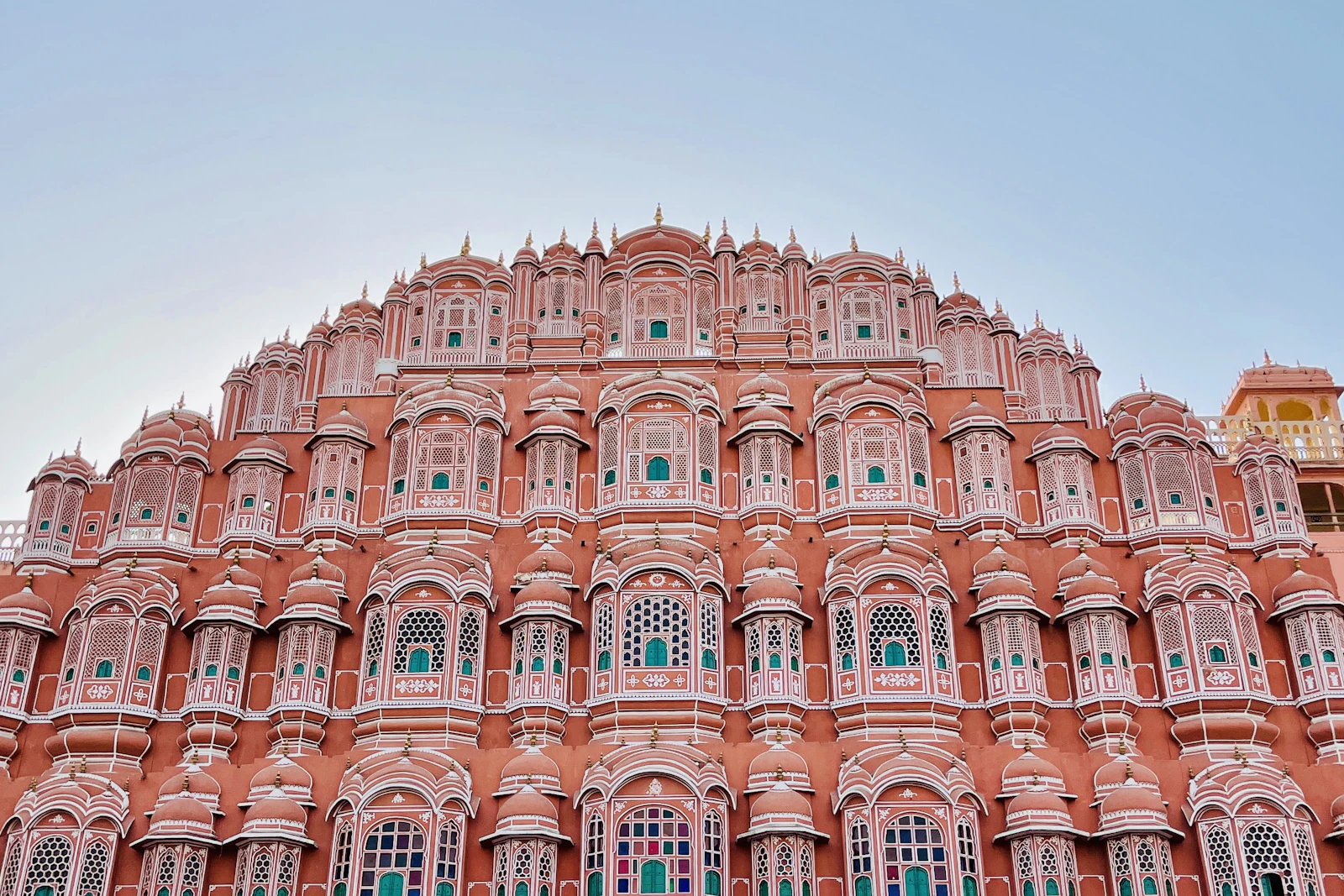
Start at Hawa Mahal before nine, from the street. Its famous face is the back of the building — a five-storey screen of 953 windows built so the women of the court could watch processions unobserved — and it takes the morning sun straight on. The entrance is round the other side, through Tripolia Bazaar, and the climb up the ramps is worth it for the view down onto the bazaar you just walked through.
From there it is ten minutes on foot to Jantar Mantar, the observatory Sawai Jai Singh II finished in 1734. Do not skip it as "some sundials". The Vrihat Samrat Yantra is the world's largest stone sundial at around 27 metres, it reads local time to roughly two seconds, and a guide who knows the instruments turns a courtyard of abstract shapes into an afternoon of physics. Hire one at the gate; an hour with a good guide costs less than most museum tickets.
The City Palace is next door and still partly lived in by the Jaipur royal family, which is why the top floors of Chandra Mahal cost extra. The ground-floor courtyards, the armoury and the two silver urns in Sarvatobhadra — each holding around 4,000 litres, made for a maharaja who would not drink anything but Ganges water on a trip to England — are the parts most people remember.
Day two: Amber, early
Amber Fort opens at eight and you want to be there when it does — both for the light on the Maota Lake reflection and because the courtyards are genuinely unpleasant by eleven. Skip the elephant rides. The animals work long shifts up a stone ramp in heat, welfare investigations have been unkind, and the same climb takes a fit person fifteen minutes on foot or a few hundred rupees by shared jeep.
Inside, the Sheesh Mahal is the set piece — a mirrored hall built so that a handful of candles read as a night sky — but the Sukh Niwas across the courtyard is the cleverer room: a channel of water runs through the marble and the wind off it was the eighteenth century's air conditioning. Leave by the Chand Pol gate rather than the way you came in and you will end up in Amber town, which most visitors never see.
Two things sit within a few minutes of the fort and take twenty minutes each:
- Panna Meena ka Kund — a symmetrical stepwell with criss-crossing stairs, free, and empty at nine in the morning.
- Anokhi Museum of Hand Printing — a restored haveli explaining block printing, and the reason the textiles in the bazaar suddenly make sense.
- Jaigarh Fort, up the hill, if you want to see Jaivana — for a long time the largest wheeled cannon in the world, fired exactly once.
Come back into town for lunch, sleep through the worst of the afternoon, and take an auto up to Nahargarh for sunset. The city goes flat and grey-pink below you and the lights come on in the grid Jai Singh laid out in 1727.
Day three: museums, markets and one long lunch
Albert Hall Museum in Ram Niwas Garden is the city's Indo-Saracenic showpiece and holds a genuine Egyptian mummy, which nobody expects. Go early, then give the rest of the morning to the bazaars — they are the real museum, and they are organised by trade rather than scattered.
- Johari Bazaar — jewellery, gemstones and the city's most serious sweet shops.
- Bapu Bazaar — textiles, block-printed cotton and juttis; the place to bargain.
- Tripolia Bazaar — lac bangles, made in front of you in workshops off the main strip.
- Chandpole — brassware and marble, and quieter than the rest.
Eat two things before you leave. Pyaaz kachori, the onion-stuffed pastry Jaipur does better than anywhere else, is a morning food and is best from a counter with a queue. Dal baati churma is a lunch — baked wheat balls drowned in ghee with lentils and a sweet crumble — and it is heavy enough that you will need the nap you were going to take anyway.
When to go, and what it costs you
October to March is the answer. November to February is genuinely pleasant, with cold mornings that make the eight o'clock fort visit a pleasure rather than a discipline. April to June runs past 40°C and reshapes the whole trip around shade. The monsoon arrives in July, drops the temperature, greens the hills around Amber and brings ghewar to every sweet shop for Teej.
Two dates are worth planning around or avoiding, depending on your tolerance for crowds: the Jaipur Literature Festival in January, which fills every hotel in the city, and Gangaur in March or April, when the processions come through the old town and the bazaars stay open late.