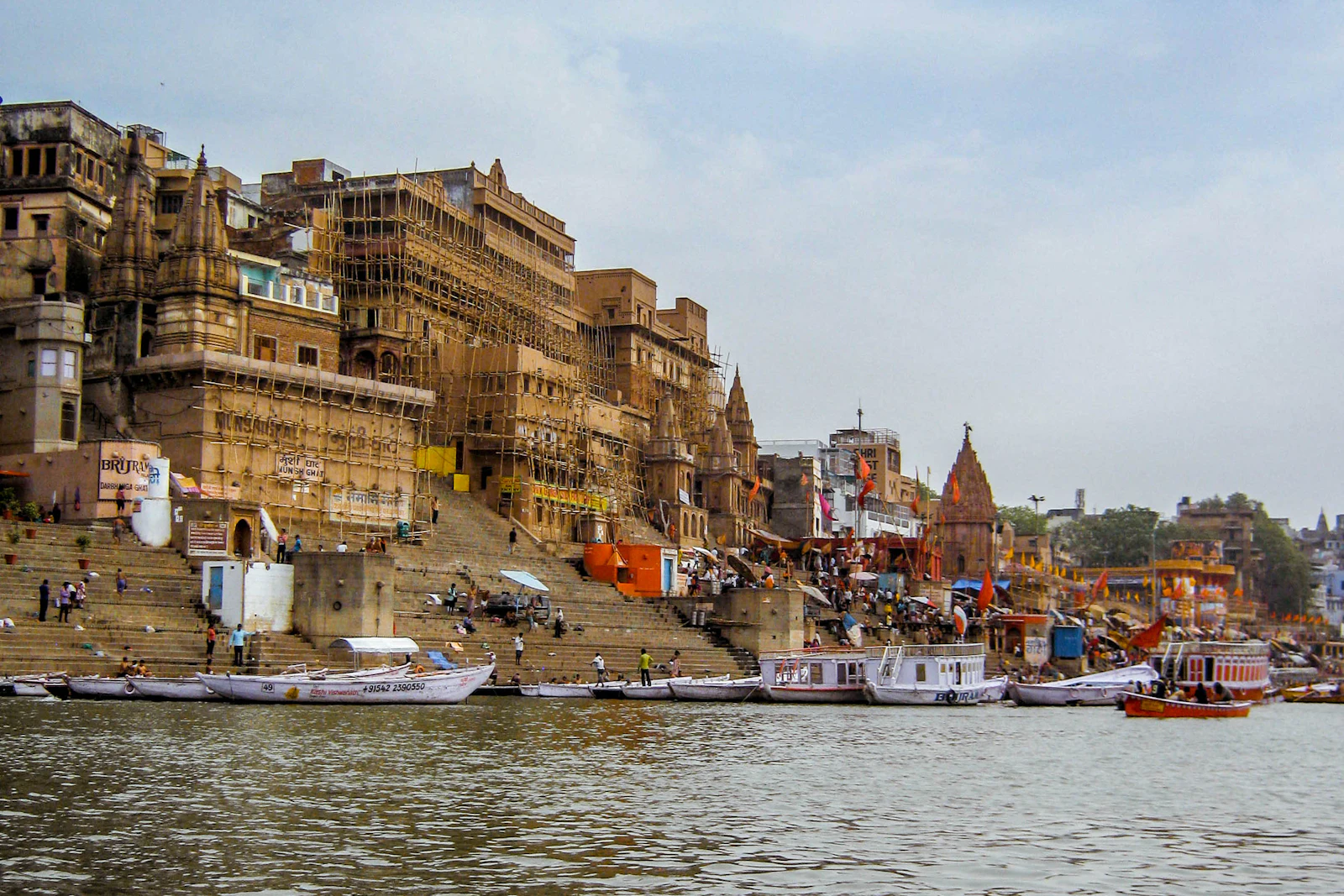
 Varanasi, Uttar Pradesh
Sunrise on the Varanasi Ghats
By Bharat Trails Editors··4 min read·
How to do the dawn boat properly, what to do with the rest of the day, and how to behave at the two ghats where people are being cremated.
Varanasi is not a city you sightsee. It is a city you walk in, get lost in, and sit down in — ideally on a step, at six in the morning, with a river in front of you. Two or three days is enough to stop feeling ambushed by it, which is roughly the point at which it becomes the best thing you will do in north India.
The boat: do it at dawn, and arrange it the night before
The dawn row is the one unmissable thing here, and it is better arranged in person the evening before than through a hotel desk. Walk down to Assi Ghat or Dashashwamedh, find a rower, agree a price and a duration out loud, and agree the direction too — you want to go upstream first while it is still dark and drift back as the sun comes up behind the east bank.
Take the rowing boat rather than the motorboat. It costs less, it does not drown out the sound of the ghats waking up, and the man rowing it has usually lived on this river his whole life. Sunrise is around 5:15 in June and closer to 6:30 in December, so check the day before rather than assuming.
Walking the ghats
There are around eighty ghats along roughly six and a half kilometres of riverfront, and you can walk nearly all of them from Assi in the south to Raj Ghat in the north. Give it two or three hours, in the morning or the last hour before dark, and let it be aimless. Dashashwamedh is the busy centre. Kedar Ghat, in striped red and white, is the most photogenic. Panchganga has the mosque Aurangzeb built on top of a temple, which is most of Varanasi's history in one building.
Behind the ghats are the galis — alleys too narrow for a car and often for two people. You will get lost. That is fine; walk downhill and you hit the river, walk uphill and you hit a road.
Manikarnika and Harishchandra
Two of the ghats are burning ghats, where cremations run continuously. Manikarnika is the larger. You are not forbidden from being there, and Hindus travel across the country for exactly this, but you are standing at somebody's funeral, so behave like it.
- Do not photograph the pyres or the families. This is the one rule with no exceptions.
- Stand back and to the side; keep out of the way of the biers coming down the steps.
- Anyone who leads you to an upper terrace and then asks for a "donation for wood for the poor" is running a known scam. There is no fee to stand and watch, and the hospices do not collect from tourists on the stairs.
- No guide is needed. If you want one, arrange it through your hotel in advance.
The rest of the day
The Ganga Aarti at Dashashwamedh at dusk is a choreographed hour of fire, bells and brass — vast crowds, and worth seeing once. If you would rather not be in it, watch from a boat moored offshore, which is what the boatmen will suggest anyway. Assi Ghat has the quieter mirror image at dawn, Subah-e-Banaras, with music and yoga on the steps as it gets light.
Sarnath is ten kilometres away and is a completely different register: green, silent, and where the Buddha gave his first sermon after his enlightenment. The Dhamek Stupa dates in its present form to around the fifth century, and the small archaeological museum holds the Ashokan lion capital that became India's national emblem. Half a day, and a useful antidote if the old city has worn you out.
Banaras Hindu University's campus, the silk-weaving workshops in Madanpura, and the Ramnagar Fort across the river are the next three things, in roughly that order.
Eat like the city does
- Kachori sabzi for breakfast, from a shop that only does breakfast — deep-fried, spiced potato curry, eaten standing up.
- Tamatar chaat and chura matar in the cold months, the second one being flattened rice with green peas and a great deal of ghee.
- Malaiyo — a winter-only milk foam, whipped overnight in the December dew, gone by March. If it is the season, eat it twice.
- Lassi in a clay cup, thick enough to need a spoon.
- Banarasi paan at the end, and be honest with the man about whether you have had it before.
When to go
October to March, and November if you can choose. Dev Deepawali, on the November full moon, is the night the entire riverfront is lit with oil lamps and the city is at its most overwhelming — book months ahead. Summer runs well past 40°C. The monsoon raises the river so far that the lower steps disappear, walking the ghats end to end stops being possible and boats are restricted, which is worth knowing before you plan a July trip around a sunrise row.