 Mumbai, Maharashtra
Art Deco and Gothic Mumbai, on Foot
By Bharat Trails Editors··5 min read·
One maidan with Victorian Gothic on one side and 1930s Art Deco on the other — a UNESCO-listed walk through the two Bombays, in about three hours.
In 2018 UNESCO inscribed something unusual on the World Heritage list: not a building but an argument. The Victorian Gothic and Art Deco Ensembles of Mumbai covers two rows of buildings facing each other across the Oval Maidan, put up roughly sixty years apart, in styles that could not disagree more thoroughly. On the east, the spires, gargoyles and pointed arches of imperial Bombay in the 1870s. On the west, the curves, chrome lettering and ziggurat parapets of a confident Indian bourgeoisie in the 1930s. You can walk the whole thing in three hours.
The scale is worth stating plainly: Mumbai holds one of the largest concentrations of Art Deco buildings anywhere in the world, generally reckoned second only to Miami. Most of them are ordinary apartment blocks that people still live in, which is why the city wears its Deco so lightly that visitors walk past a hundred examples without registering one.
Start: CSMT, the Gothic maximum
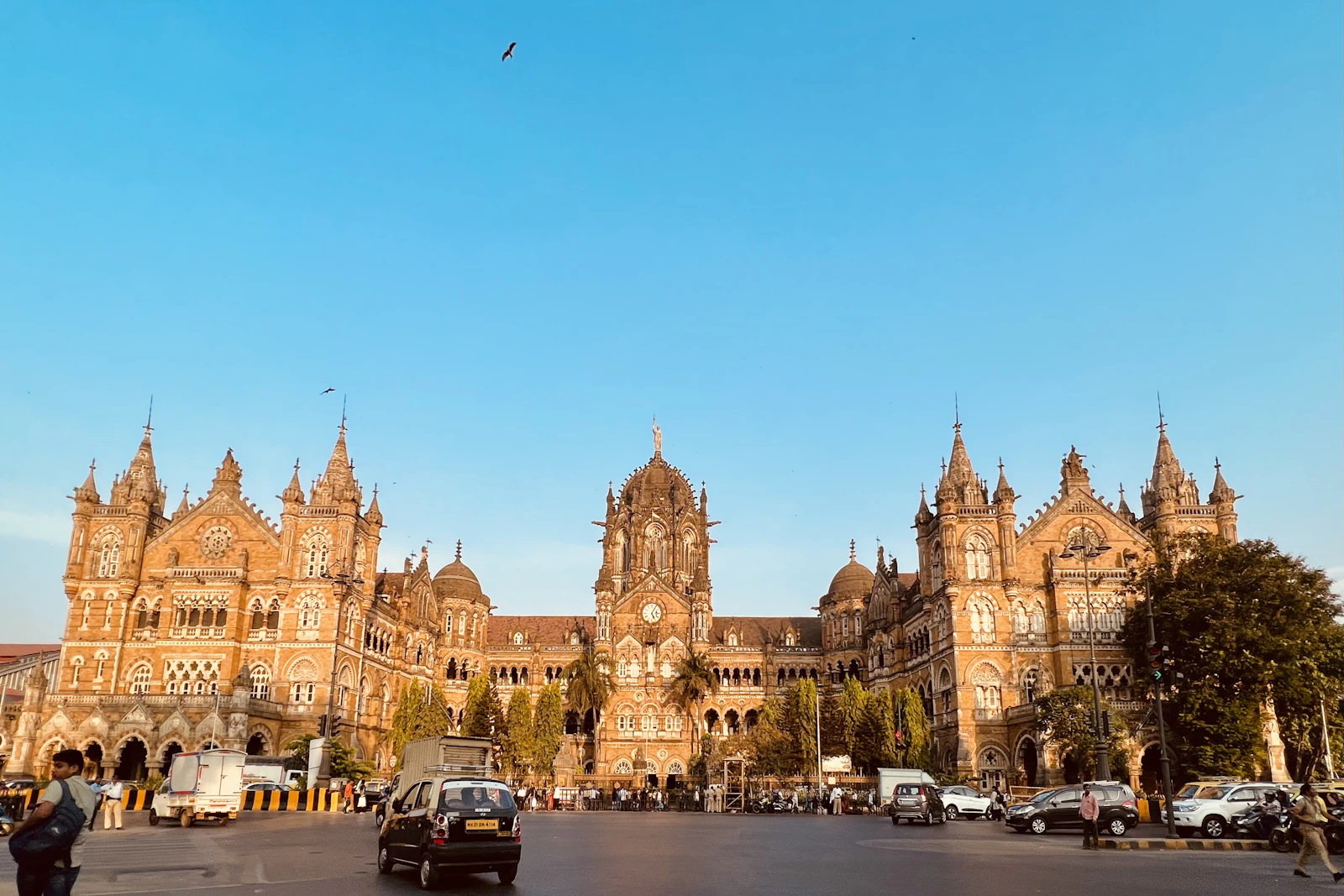
Begin at Chhatrapati Shivaji Maharaj Terminus, completed in 1888 to Frederick William Stevens' design after a decade of building, and a World Heritage Site in its own right since 2004. It is Venetian Gothic crossed with Mughal detail and it is covered in things nobody notices: a monkey and a lion flanking the entrance gates for India and Britain, stone peacocks, portrait medallions of the railway's directors, and a statue of Progress on the central dome. Stand across the road by the traffic island for the full frontage — from the pavement below you can only see about a third of it.
Next door, the Municipal Corporation building of 1893 is Stevens again, wedged onto an awkward triangular plot and arguably the cleverer piece of design. Walk south down Dr Dadabhai Naoroji Road, past the Gothic and neoclassical banks, to Flora Fountain — a Portland stone fountain of 1864 in a square now officially named Hutatma Chowk after the Samyukta Maharashtra martyrs of 1960. The stone was shipped from England and the goddess on top has been slowly dissolving in the salt air ever since.
The Oval Maidan: both sides, one lawn
Walk into the Oval and turn to face east. In a single sweep you get the Bombay High Court of 1878, its towers topped by figures of Justice and Mercy; the Rajabai Clock Tower, finished the same year, eighty-five metres tall and modelled loosely on the Big Ben tower, paid for by the financier Premchand Roychand and named for his mother; the University Convocation Hall beside it; and the old Public Works Department Secretariat of 1874 at the southern end. It is the most concentrated stretch of Victorian Gothic outside Britain, and it was built on what had been the shoreline.
Now turn a hundred and eighty degrees. The western edge of the maidan is a solid wall of 1930s Art Deco apartment blocks, built on land created by the Backbay Reclamation Scheme, with names — Court View, Palm Court, Empress Court, Ram Mahal — that were as much marketing as address. These are the buildings to look at closely: rounded corner balconies, horizontal 'eyebrow' sunshades over the windows, stepped ziggurat parapets, coloured terrazzo, and the original hand-cut nameplate typography which is the single most photographed detail in Mumbai architecture circles.
At the maidan's northern corner is Eros Cinema, built in 1938 by Sohrabji Bhedwar in red Agra sandstone with a stepped tower, the most theatrical Deco building in the city. Deco arrived in Bombay after the 1925 Paris exhibition and was taken up enthusiastically by Indian industrialists and Parsi developers precisely because it was modern and not imperial — choosing it was a statement about who was building the city now.
South and west: Marine Drive and the cinemas
Marine Drive is the other half of the Deco story: a continuous crescent of 1930s and 1940s apartment buildings along the reclaimed seafront, built for the same market and with the same vocabulary, now weathered by seventy years of salt spray. Soona Mahal at the Churchgate end, Zaver Mahal, Chateau Marine and Kapur Mahal are the ones usually pointed out, but the pleasure is in walking the row and noticing that no two parapets are the same. Nautical detailing — porthole windows, railings, prow-shaped corners — runs throughout, which the architects intended as a seaside joke and which reads now as deadly serious.
The cinemas are the other Deco set, and several still show films:
- Regal, at Colaba, opened 1933 — designed by Charles Stevens, son of the man who built CSMT, and the first air-conditioned cinema in India. The interiors are by the Czech artist Karl Schara.
- Eros, at Churchgate, 1938 — the red sandstone tower at the Oval's corner.
- Metro, at Dhobi Talao, 1938 — built for MGM, with a marble-and-mirror foyer.
- Liberty, at Marine Lines, 1947 — the last of the line, opened in the year of independence and consciously late-Deco.
- New India Assurance Building on Mahatma Gandhi Road, 1936 — not a cinema, but the bas-relief figures of Indian workers on its facade are the best Deco sculpture in the city.
If you want to keep going
Horniman Circle, a neoclassical arcaded crescent laid out around a garden in the 1860s, is five minutes east and is where the walk is best finished. The Asiatic Society's Town Hall on its edge, completed in 1833, has thirty Doric columns and a flight of steps that the city uses as a grandstand. Ballard Estate behind it is Edwardian and uniform, laid out by George Wittet — who also designed the Gateway of India and the Prince of Wales Museum — and is the closest Mumbai gets to a planned European quarter.
Further out, the Dr Bhau Daji Lad Museum in Byculla, restored to its 1872 interiors of gilt columns and Minton tile, is the most beautiful room in the city and almost always empty. The Art Deco Mumbai Trust publishes a catalogue and occasional guided walks, and is the best source if this turns into an interest rather than a morning.