 Mumbai, Maharashtra
Your First 48 Hours in Mumbai
Par Bharat Trails Editors··5 min de lecture·
Two days that make sense of a city of twenty million: the island fort, the ferry to Elephanta, the local trains, and the hour Marine Drive turns gold.
Mumbai is not a city you see; it is a city you get the hang of. It has no single monument that justifies the trip and no historic core you can walk end to end. What it has is a shape — a narrow peninsula, built on seven islands that were joined by reclamation over two centuries, with everything old at the southern tip and twenty million people living up the length of it. Two days spent understanding that shape will leave you far better off than two days chasing a list.
A little history makes the map legible. The islands came to the Portuguese in the sixteenth century, passed to Charles II of England in 1661 as part of Catherine of Braganza's dowry, and were leased to the East India Company in 1668 for ten pounds a year, which remains the best property deal in recorded history. The causeways that welded the islands together created the flat southern district where almost everything on day one is located.
Day one: the southern tip
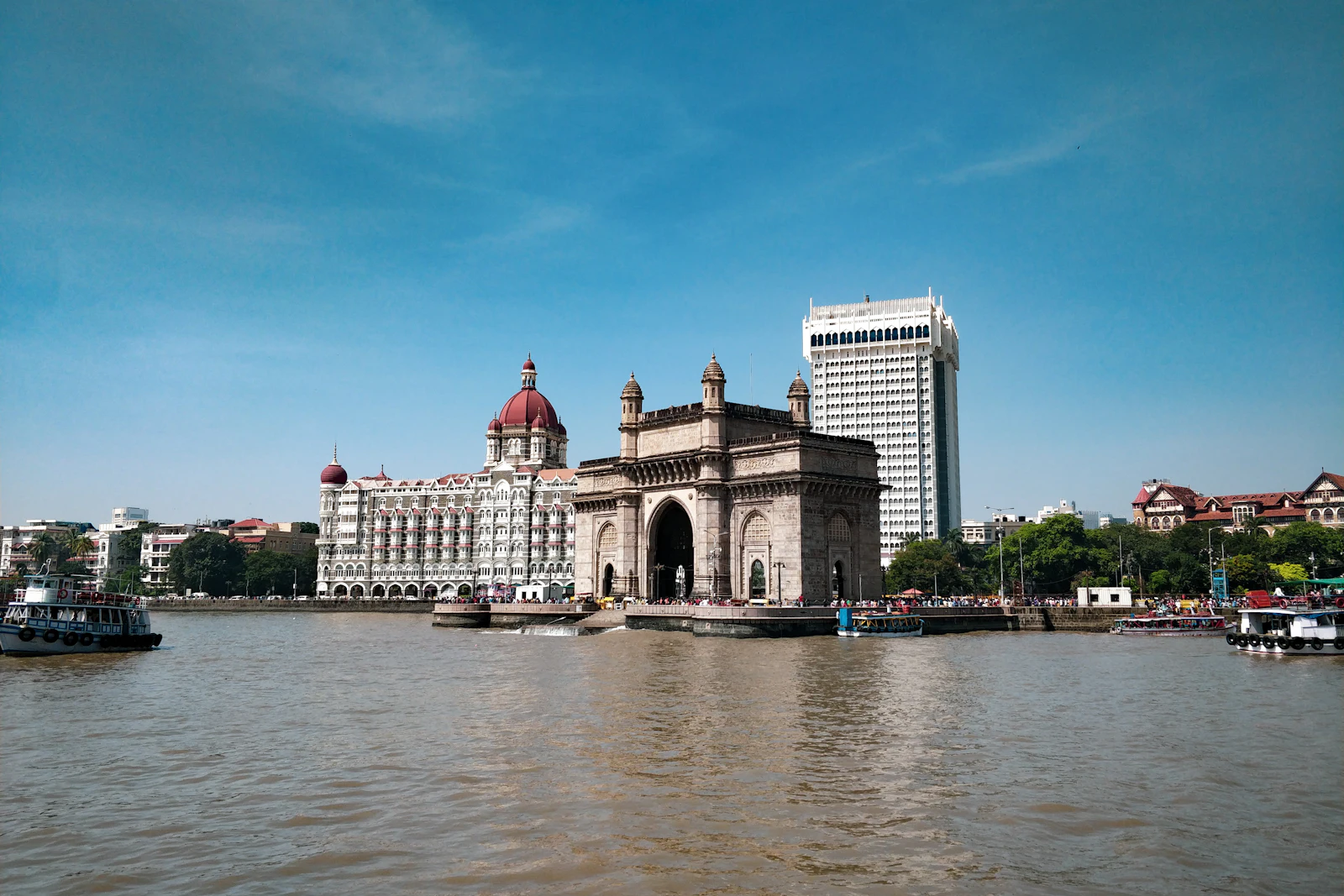
Start at the Gateway of India at eight, before the crowds and the photographers. It was completed in 1924 to commemorate the 1911 visit of George V and Queen Mary — so it postdates the event it marks by thirteen years — and it acquired its real meaning in 1948, when the last British troops in India marched out through it to their ships. Behind it stands the Taj Mahal Palace, opened in 1903, whose founding story you will be told by six separate people.
From the jetty beside it, take the ferry to Elephanta Island: about an hour each way, and the crossing itself is the best way to grasp the harbour. The caves are fifth to eighth century, cut into basalt, and the six-metre Trimurti — three faces of Shiva emerging from the rock — is genuinely one of the great pieces of Indian sculpture. The island is closed on Mondays, the last boats back leave in the late afternoon, and there is a stiff flight of steps from the jetty lined with stalls.
Back on land, walk north through Colaba Causeway and into Kala Ghoda. This is the museum district: the Chhatrapati Shivaji Maharaj Vastu Sangrahalaya, built in 1915 and still universally called the Prince of Wales Museum, the Jehangir Art Gallery, the David Sassoon Library with its garden of sleeping readers, and the blue Knesset Eliyahoo synagogue of 1884. Finish at Marine Drive for sunset — the three-kilometre curve whose streetlights earned it the name Queen's Necklace — and walk it to Chowpatty, where the beach food starts at dusk.
Day two: how the city actually works
Spend the morning on the things that are Mumbai rather than colonial Bombay. Dhobi Ghat at Mahalaxmi is the open-air laundry where thousands of items are washed daily in concrete pens; the bridge above it is the viewpoint, and the walk down into it should be done with a local guide or not at all. Haji Ali Dargah, built in 1431, sits on an islet reached by a causeway that is submerged at high tide — check a tide table or you will simply be looking at it. Banganga Tank at Walkeshwar is a stepped water tank of 1127, surrounded by temples and pigeons, and is the oldest continuously used thing in the city.
In the afternoon, go north to Bandra: Bandstand for the seafront promenade, Mount Mary church above it, and the lanes of Chapel Road and Ranwar village, where Portuguese-era cottages are covered in street art and the whole neighbourhood feels like a different city with a better coffee supply.
- Vada pav — a spiced potato fritter in a bun with dry garlic chutney. The city's defining food, sold everywhere, and best from a cart with a queue at five in the evening.
- Bademiya, in the lane behind the Taj — kebabs and rolls off a street grill since 1946, and busiest close to midnight.
- Pav bhaji at Sardar in Tardeo, which uses an amount of butter that should be reported to somebody.
- Bhelpuri and pani puri on Chowpatty beach at dusk, the one place where eating it standing on sand is the correct way.
- Britannia & Co in Ballard Estate for berry pulao — a Parsi restaurant of 1923 serving a dish invented there, using barberries brought from Iran.
Getting around, and what to avoid
The suburban rail network carries something like seven and a half million people a day and is the fastest way to move north to south. Ride it, but not between eight and eleven in the morning or five and nine in the evening, when the crush is genuinely dangerous rather than merely uncomfortable. Buy a first-class ticket, which costs several times second class and is still trivial, and use the ladies' compartments if they apply to you — they are much calmer. Never ride in a doorway.
The newer metro lines are air-conditioned and pleasant but do not yet cover the southern tip, which is the part you most want on day one. Black-and-yellow taxis run on meters in the south and app cabs work everywhere; autorickshaws are not permitted below Bandra, which surprises people who try to take one to Colaba.
As for season: October to February is the answer — dry, warm, and by January genuinely pleasant. March to May is hot and humid in a way that is worse than dry heat. The monsoon runs June to September and Mumbai receives something in the order of 2,200 millimetres of rain, a large share of it in a handful of spectacular days. The city is beautiful in it and it floods; if you come then, keep your plans local and expect at least one day where the sensible thing is to stay put with a window.