 Jaipur, Rajasthan
Shopping in Jaipur: Block Print, Gems and Bazaars
Par Bharat Trails Editors··5 min de lecture·
Sanganer versus Bagru printing, why blue pottery has no clay in it, and the gemstone rules that keep visitors out of trouble in Johari Bazaar.
Jaipur is the best shopping city in north India and the easiest one to be quietly overcharged in, and both facts have the same cause: almost everything sold here is genuinely made here, by people whose craft has a real technical vocabulary that the visitor does not have. Learn about four hundred words of that vocabulary and the whole thing changes. You stop buying 'a printed scarf' and start buying a Bagru dabu resist print, at which point nobody tries the tourist price on you.
Block print: the difference between Sanganer and Bagru
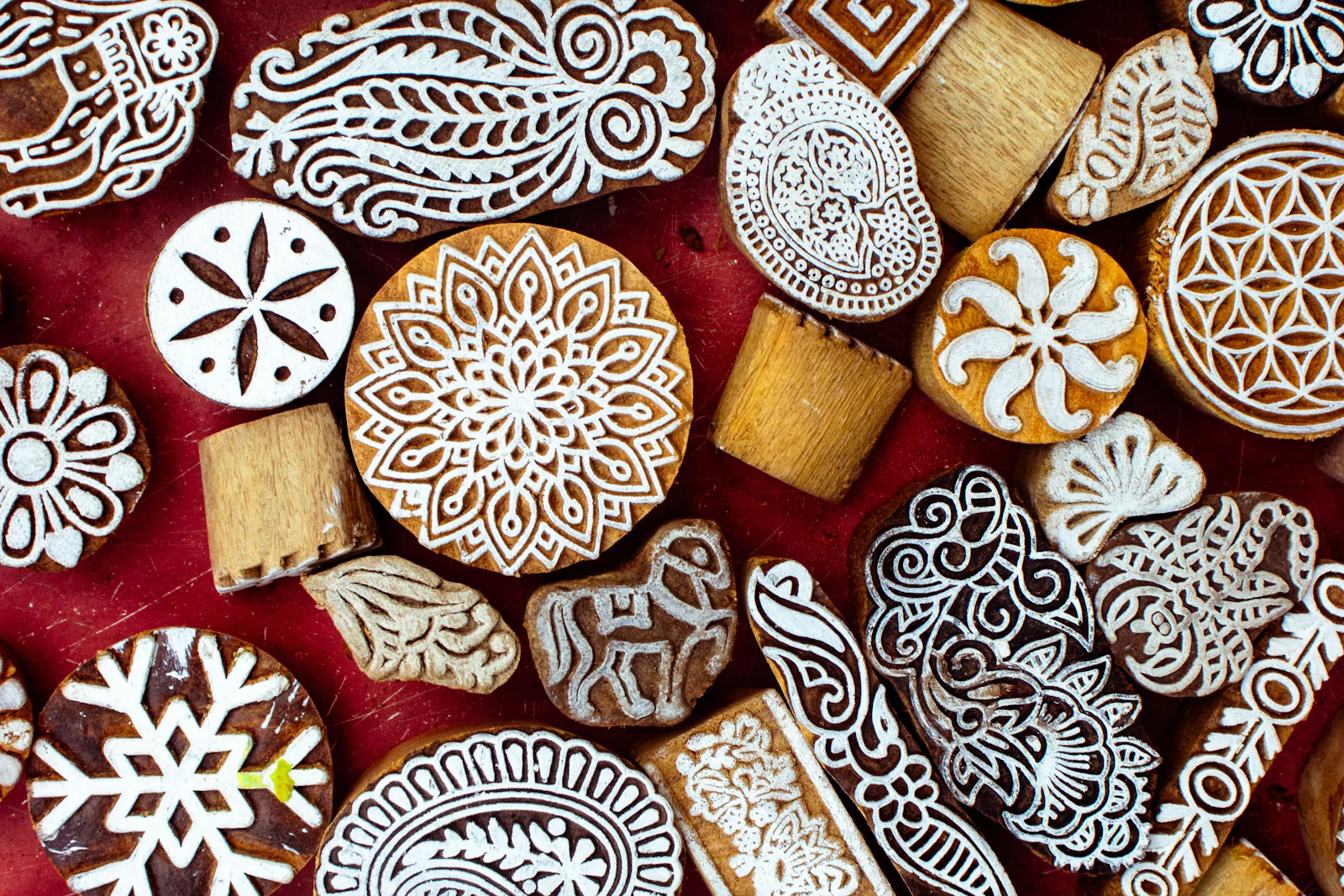
Two villages outside Jaipur print almost everything you will see, and they do it in opposite ways. Sanganer, to the south, prints directly onto white or cream cotton — fine floral repeats, clear outlines, bright colours, a lot of them now chemical dyes. Bagru, to the west, works the other way round: artisans stamp a mud-and-gum resist called dabu onto the cloth, dye the whole piece, and the resisted areas stay pale. Bagru's palette is therefore the palette of natural dyes — madder red, indigo, iron-black, turmeric yellow — and its patterns are bolder and geometric because a resist paste cannot hold a hairline.
Neither is better. But a Bagru piece involves several more days of work than a Sanganer piece, and a screen-printed imitation of either involves none. Look at the reverse of the fabric: a real block print penetrates the cloth and the back is nearly as strong as the front. Look for small registration errors where one block meets the next — those are the signature of a hand, and a flawless perfect repeat usually means a screen or a roller. Real natural-dye Bagru also smells faintly of iron and earth when new.
The Anokhi Museum of Hand Printing in Amber, set in a restored haveli, demonstrates the whole process including live printing and block carving. An hour there before you shop is worth more than any amount of bargaining skill.
Gemstones: the rules that keep you out of trouble
Jaipur is one of the world's great gem-cutting centres, particularly for emeralds, and the trade is concentrated in Johari Bazaar and the lanes behind it — Gopalji ka Rasta and Haldiyon ka Rasta, where you can watch stones being cut on foot-powered wheels in first-floor workshops. It is a real industry and most of it is honest. The part that is not is aimed squarely at visitors, and it runs on one narrative: that you are being let in on a wholesale price, and that you could resell the stones at home for several times what you pay.
- Never buy a gemstone as an investment, and walk out of any shop that mentions resale, export margins or a buyer waiting in your home country. That is the whole of the scam, and it has been running for decades.
- Never go to a gem shop a driver, guide or a new friend at a café suggested. Commissions are 30 to 40 per cent and they come out of your price.
- Buy the stone you like at a price you are happy to have simply spent. Treat any certificate handed to you in the shop as decorative.
- Ask for a proper GST invoice with the shop's name, the stone, the weight and the treatment disclosed. Pay by card where you can, so you have a route to dispute.
- Silver sold by weight against the day's posted rate, plus a stated making charge, is the most transparent purchase in the city. If you want jewellery and not risk, buy silver.
Blue pottery, lac and the rest
Jaipur blue pottery contains no clay at all. The body is quartz powder, powdered glass, fuller's earth, borax and gum, which is why it fires at a low temperature, why it is so light in the hand, and why it chips rather than cracks. The technique came to Rajasthan from Persia via Mughal Delhi and was nearly dead by the 1950s until Kripal Singh Shekhawat revived it. Traditional pieces stay in cobalt blue, copper green and white; anything in pink or yellow is a modern liberty. It is not food-safe glaze in every workshop, so ask before buying a dinner plate.
Lac bangles are made in the lanes off Tripolia Bazaar — Maniharon ka Rasta is the one to ask for — and they are shaped over a small flame in front of you, sized to your wrist on the spot. They cost very little and they break if you sit on them, which is part of the arrangement.
For everything else, the bazaars are sorted by trade, which makes comparison easy:
- Johari Bazaar — gems, gold, kundan and meenakari enamel work, plus the city's most serious sweet shops.
- Bapu Bazaar — textiles, block-printed cotton, and mojari and jutti leather slippers. The main bargaining ground.
- Nehru Bazaar — more of the same, usually a shade cheaper than Bapu, and less used to tourists.
- Tripolia Bazaar — lac bangles, brass and ironware.
- Chandpole — marble carving and brassware, and the quietest of the lot.
- Kishanpole Bazaar — wooden furniture, carved doors and the block printers' own supply shops.
Use Rajasthali, the state government emporium on Mirza Ismail Road, as a free price anchor. Everything there is fixed-price and slightly above market, but walking the floor for twenty minutes tells you what a metre of Bagru cotton, a blue pottery bowl and a pair of juttis actually cost. Then go and bargain in the bazaar with real numbers in your head — open at about half of a first quote in Bapu Bazaar, and expect to settle near sixty per cent.