 Udaipur, Rajasthan
Photographing Udaipur: Lakes and Palaces
Par Bharat Trails Editors··5 min de lecture·
Where to stand for the City Palace reflection, which ghat gets the blue hour, and the sunrise hills above Lake Pichola. A photographer's route through Udaipur.
Udaipur is the most photographed city in Rajasthan and most of those photographs are taken from three or four spots, at the wrong hour, by people who found them by accident on the last afternoon. The city is built around water and faces west, which means almost everything worth shooting is a question of which bank you are standing on and what time it is. Get those two right and Udaipur is close to unfair.
A little geography helps. Lake Pichola is artificial, dug in 1362 by a banjara grain trader named Pichhu and considerably enlarged by Maharana Udai Singh II after he founded the city in 1559. The City Palace runs along its eastern shore. The old town, the ghats and the hotels sit behind it. The western bank — Ambrai, Hanuman Ghat — faces back across the water at all of it, and that is where the famous view is taken from, not from the palace itself.
Blue hour: Ambrai Ghat, west bank
The picture everyone knows — the City Palace lit gold, the whole thing doubled in still water — is shot from the west bank around Ambrai Ghat and Amet Haveli, in the twenty minutes after sunset when the palace floodlights come on but there is still blue in the sky. Turn up forty minutes early, because there are perhaps a dozen good positions and they are taken. A tripod or a wall to brace on matters more than any lens; the light drops fast and the reflection only works if the water is dead flat, which is a dawn-and-dusk phenomenon.
For the reverse view, Gangaur Ghat on the old-town side is the wide, stepped ghat with the triple-arched Tripolia gate, and it is at its best in the first hour of daylight when women are washing at the steps and the light is coming over the shoulder of the town. Lal Ghat's rooftop cafés give you elevation over the same scene for the price of a coffee.
Sunrise: the hills, not the water
At dawn the interesting light is above the city, not on it. The Karni Mata ropeway climbs Machla Magra behind the City Palace in about four minutes and puts you level with the whole lake system — Pichola, the two island palaces, Fateh Sagar beyond — with the sun coming up behind you. It is usually sold as a sunset ride, and sunset is more crowded and shoots directly into the light. Take the first car of the morning instead.
Badi Lake, about twelve kilometres out, is the other dawn option: an eighteenth-century reservoir with a low hill and a marble chhatri above it, empty at six in the morning, and mist on the water in the cold months. Sajjangarh — the Monsoon Palace, built in 1884 by Maharana Sajjan Singh on a hilltop inside a wildlife sanctuary — is the classic sunset viewpoint over the whole lake basin. Check the sanctuary gate's closing time before you go up; it is enforced, and it is earlier than sunset in winter.
Inside the palaces
The City Palace is the largest palace complex in Rajasthan, built over four hundred years from 1559 by twenty-two successive maharanas, which is why it reads as eleven palaces jammed into one silhouette. For photographs, three rooms do most of the work:
- Mor Chowk — the peacock courtyard, with three peacocks of the 1870s built from thousands of pieces of coloured glass mosaic. It faces east; go in the morning while the court is still lit.
- Badi Mahal — a garden courtyard set high enough on the natural rock that there are mature trees growing at what is effectively the fourth floor.
- Zenana Mahal and the Sheesh Mahal fragments — mirror work and stained glass, where the shot is the coloured light falling on the floor rather than the window itself.
- The Toran Pol and the main ramp on the way in, where the scale of the outer wall against a person is the only way to convey how big this thing is.
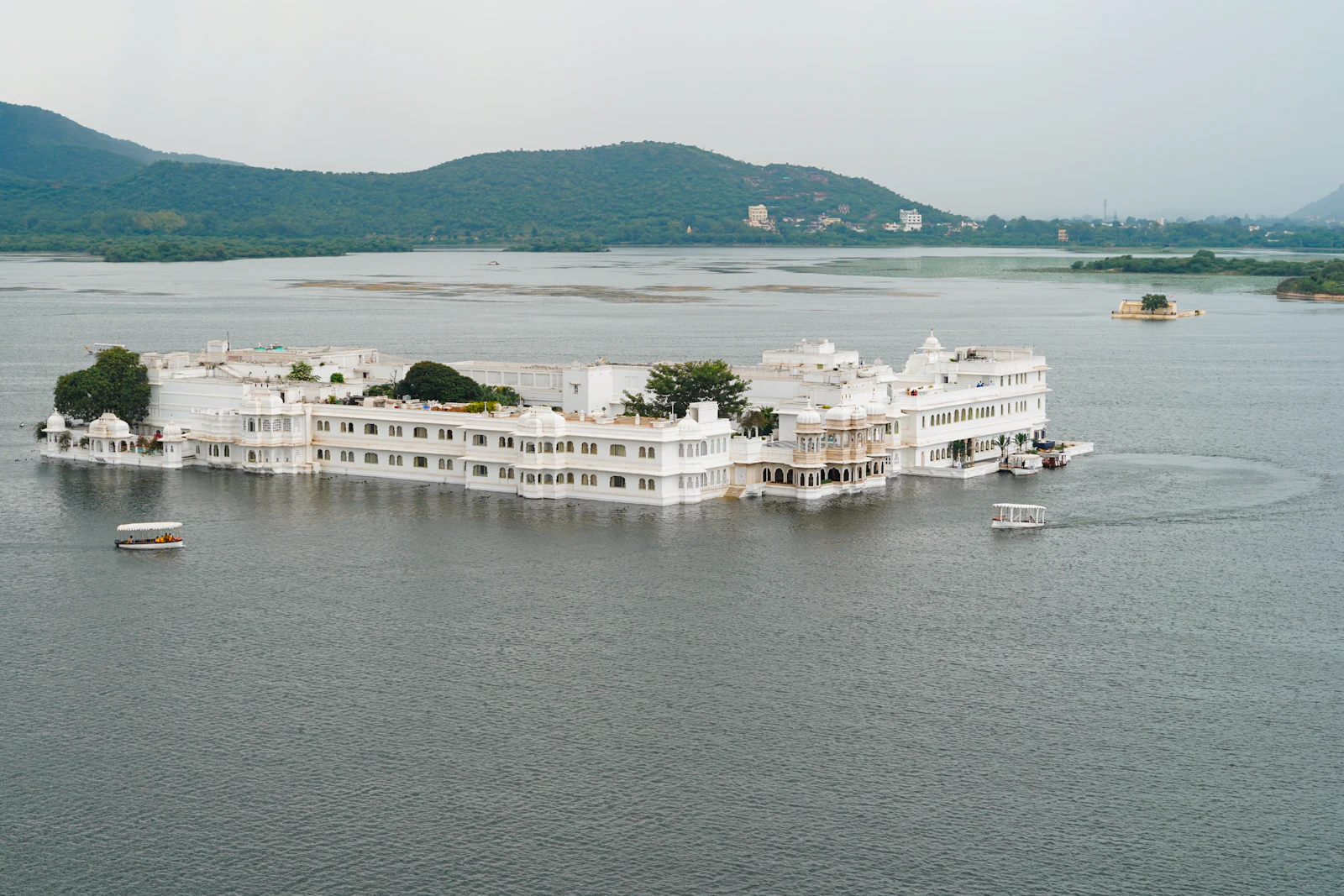
Jag Niwas — the Taj Lake Palace, completed in 1746 for Maharana Jagat Singh II — cannot be visited unless you are staying or dining there, so it is a subject, not a destination. Jag Mandir, the other island, can be visited by boat and is the better one to walk on anyway: it is where Prince Khurram, later Shah Jahan, sheltered in 1623 during his revolt against his father, and the elephants along its landing are the frame everyone uses.
Boats leave from the Rameshwar Ghat jetty inside the City Palace complex, and require a palace ticket on top of the boat fare. The sunset departure is the one that sells out; the mid-morning one is half empty and gives you flat light on white marble, which is not bad at all.
The rest of the route
Jagdish Temple, built in 1651, sits a couple of minutes above Gangaur Ghat up a flight of thirty-two steps flanked by stone elephants — a working Vishnu temple, busy at aarti, and the carving on the outer walls repays a slow circuit. Saheliyon ki Bari, laid out in the early eighteenth century as a garden for the maharana's women, has fountains that run on gravity alone from the lake above and no pumps at all. Bagore ki Haveli on Gangaur Ghat runs a folk dance and puppet show at seven every evening, which is the one reliable place to photograph Rajasthani dance in decent light.