 Delhi
DelhiOld Delhi and New Delhi in Two Days
Par Bharat Trails Editors··6 min de lecture·
Old Delhi and Lutyens' Delhi are two different cities with one name. A first-timer's two-day plan that treats them that way, and uses the metro between.
Most people arrive in Delhi expecting one city and find two, laid out about four kilometres apart and built three hundred years apart, with nothing in common but a name. Shahjahanabad — what everyone now calls Old Delhi — was founded in 1639 as Shah Jahan's new capital, and it is a walled medieval town with lanes narrow enough to touch both walls. New Delhi was drawn on paper by Edwin Lutyens and Herbert Baker and inaugurated in 1931, and it is roundabouts, bungalows and avenues wide enough to land a plane on. Trying to see both in the same afternoon is the single most common way to have a bad time here.
So give each one a day. Two days will not exhaust Delhi — eight capitals have been built on this plain and the ruins of most of them are still standing in somebody's neighbourhood park — but two days will give you the shape of the place, which is the thing first-timers actually lack.
Day one: Shahjahanabad, on foot and early
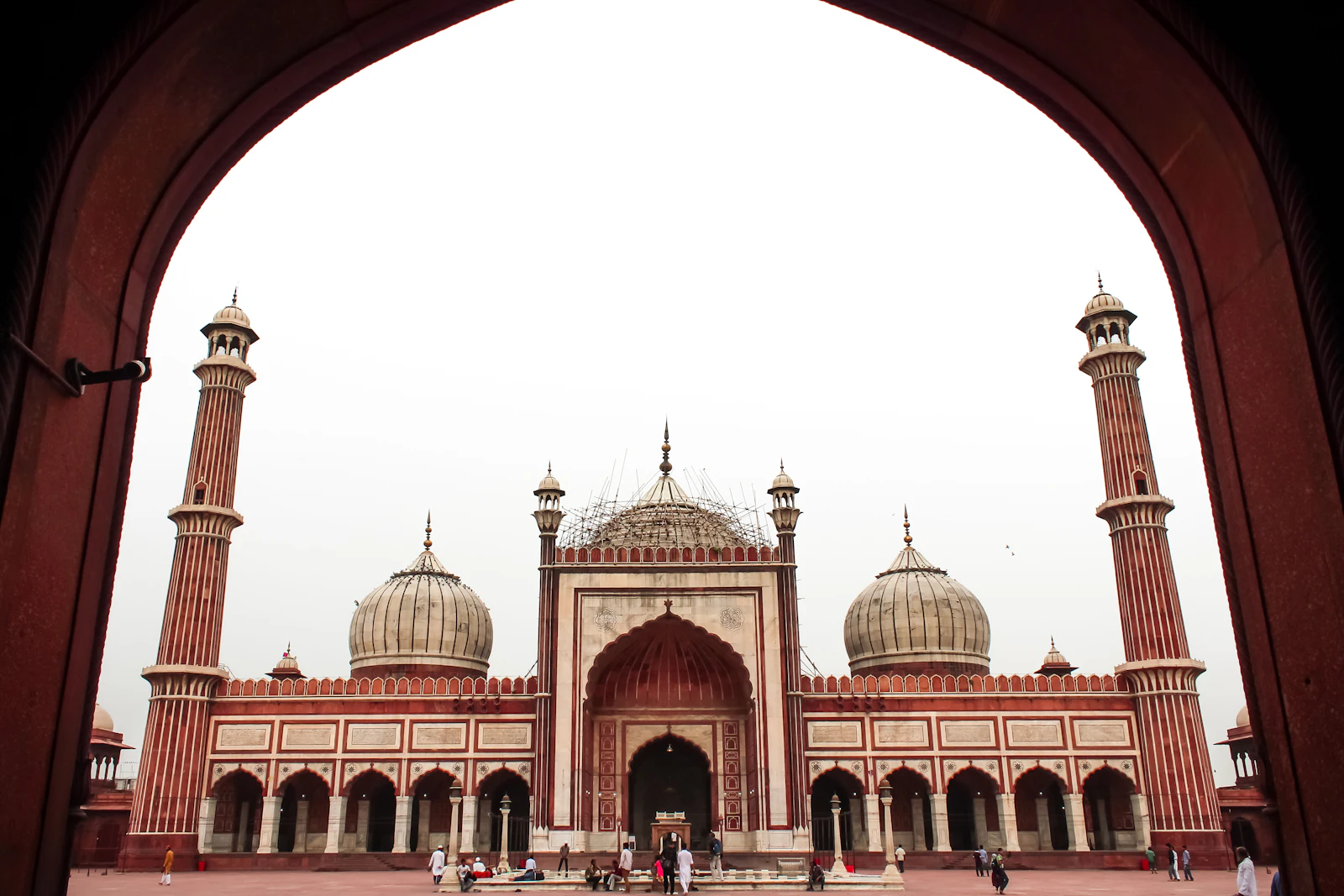
Start at Jama Masjid by half past eight. It was completed in 1656, took five thousand workers and six years, and its courtyard holds twenty-five thousand people, which is a number you only believe once you are standing in the middle of it. Climb the southern minaret if it is open — it is a tight, unlit spiral and worth every step for the view down onto the rooftops of the old city, which from up there look like one continuous surface of water tanks and satellite dishes. Cover your shoulders and legs, leave your shoes at the gate, and ignore anyone at the entrance offering to be your guide for a fixed donation.
From the mosque's northern gate you fall straight into Chandni Chowk. The avenue was laid out in 1650 by Jahanara Begum, Shah Jahan's eldest daughter, with a canal running down its centre that reflected the moon — hence the name, moonlight square. The canal is long gone and the avenue has been pedestrianised in stretches, but the trades are still sorted the way they were: Dariba Kalan for silver, Kinari Bazaar for wedding trim and zardozi, Nai Sarak for books, Khari Baoli for spices. Walk it rather than taking a cycle rickshaw if you can — the lanes that matter are too narrow for one anyway.
Eat early and often. Paranthe Wali Gali does exactly what its name promises and has since the 1870s. Karim's, in the lane behind Jama Masjid, has been run by the same family since 1913 and is the reason many people come to this part of town at all. Jalebi Wala, on the Dariba corner, has been frying since 1884 and sells jalebi by weight, hot, which is the only acceptable temperature.
The Red Fort is a ten-minute walk east and it is the one monument here that people routinely find underwhelming, mostly because they expect the Red Fort of Independence Day television and find a fair amount of empty lawn. Go anyway, but go for specific rooms: the Diwan-i-Khas, where the Peacock Throne stood until Nadir Shah carried it off in 1739, and the Naubat Khana, where musicians played five times a day. It is closed on Mondays.
Day two: the imperial city, and the older ruins under it
New Delhi reads best as a piece of deliberate geometry. Stand at India Gate — a 1931 war memorial carrying the names of more than thirteen thousand soldiers — and look west down Kartavya Path, renamed from Rajpath in 2022. The axis runs dead straight to Rashtrapati Bhavan, Lutyens' viceroy's house, which has 340 rooms and a dome that quotes the Buddhist stupa at Sanchi rather than anything European. The trick Lutyens built in, and then regretted, is that as you walk up the rise the dome sinks below the horizon of the road. You cannot get inside without booking a tour in advance, but the gates and the Secretariat blocks flanking it are the point.
Then break the imperial theme with the two monuments that are older than every wall in Old Delhi:
- Humayun's Tomb, finished around 1570 and commissioned by the emperor's widow Bega Begum. It is the first great garden-tomb on the subcontinent, the prototype the Taj Mahal refined eighty years later, and a UNESCO site since 1993. Go late afternoon for the light on the red sandstone.
- The Qutub Minar complex in Mehrauli, begun in 1199. The minaret is 72.5 metres of fluted sandstone and marble, the tallest brick minaret in the world, built across four reigns by builders who each changed the style.
- The iron pillar in the same courtyard, a fourth-century column moved here from elsewhere, which has stood in the open for sixteen hundred years and has essentially not rusted. Metallurgists are still writing papers about it.
- Nizamuddin Dargah, a few minutes from Humayun's Tomb, where qawwali is sung on Thursday evenings after sunset. It is a working shrine, not a monument — dress accordingly and follow the crowd's lead.
If you want one more, make it Lodhi Garden: ninety acres of park with fifteenth-century Sayyid and Lodhi tombs standing in it, used daily by joggers and picnickers who have entirely stopped noticing them. It is the most Delhi thing in Delhi.
When to come, and the one thing nobody warns you about
October to March is the season, and February and March are the best of it — warm days, cool mornings, everything in Lodhi Garden flowering. April to June regularly passes 45°C and there is no version of this itinerary that survives it. The monsoon arrives around the end of June and makes the city green and the traffic worse.
The thing to plan around is air quality. From roughly late October to early January, stubble burning in neighbouring states combines with winter temperature inversion and Delhi's own traffic, and the air can sit in the hazardous band for days at a stretch. It is not a reason to cancel a trip, but it is a reason to check a reading before you commit to a whole day outdoors, to keep a decent mask in your bag, and — if you have asthma or you are travelling with small children or elderly parents — to favour February and March over November.